.svg)


Want more students to participate? The research is clear.

Jennifer Harper

8 minutes
.jpg)
We’ve all been there.
You ask a question, look around the room, and wait.
A few students avoid eye contact. A few look like they’re thinking. One or two students jump in—but the conversation doesn’t quite get where you hoped it would.
You know discussion can help them connect concepts, challenge assumptions, and think more deeply about course material. You know that hearing students’ interactions will help you identify where the knowledge gaps are. But getting students to participate can be challenging.
The good news is that meaningful student engagement is possible in all classes, for all students.
Decades of research on learning show us there are effective ways to help students participate more actively, think more deeply, and take a greater role in the learning process.
At Soomo, we use this research when developing our webtexts and the resources that support instructors who use them. We know that understanding how students learn is just as important as understanding what they need to learn.
In this post, we’ll explore active learning—what the research says about why it works and how the new Soomo Teaching Handbook helps instructors turn learning science into classroom practice.
The research is clear: Active learning works
If you’re a professor, you’ve most likely heard of active learning, and you’re probably already incorporating some active learning strategies into your courses, whether or not you’re using that name.
In a nutshell, active learning means creating opportunities for students to actively engage with ideas rather than simply receive information.
Instead of only listening to a lecture or reading course materials, students are asked to do something with what they are learning.
They might
- explain a concept in their own words,
- discuss an idea with a classmate,
- apply a theory to a real-world example,
- solve a problem or analyze a scenario, or
- reflect on what they understand and where they still have questions.
Implementing active learning doesn’t mean eliminating lectures. It just means allotting class time to help students process and apply course material.
And research shows that this approach works.
In a meta-analysis of 225 studies across STEM courses, Freeman et al. (2014) found that students in active learning classrooms performed better on exams and were less likely to fail than students in traditional courses that relied exclusively on continuous lecturing.
More recently, Kozanitis and Nenciovici (2022) found similar benefits across humanities and social science courses, with active learning leading to improved student performance.
We know active learning works. But it can be challenging to put it into practice.
Active learning requires effort
Active learning can sound simple in theory.
Ask students to discuss a question with a partner. Put students into groups to solve a problem. Have students reflect on what they learned.
But the truth is: Active learning requires significant upfront effort from the instructor.

That effort involves making intentional choices at every stage: Which activity structure aligns best with my learning outcomes? How do I group students efficiently? How do I guide student responses in real time?
Thoughtful planning and facilitation turn those decisions into smooth classroom routines, keeping the focus entirely on learning rather than logistics.
That’s where practical support can make a difference. Instructors shouldn’t have to start from scratch every time they want to try a new activity or approach. The right resources can make it easier to plan, try something new, and build on what works.
At Soomo, we’ve been working to provide that support alongside our webtexts. Our instructor guides give instructors ready-to-use, chapter-specific activity ideas while our new Teaching Handbook provides practical guidance for planning and facilitating those activities.
We equip instructors with resources to help put active learning into practice
We believe course materials should do more than deliver content. They should equip instructors to create meaningful learning experiences that support student success. That’s why we design our webtexts around clear learning outcomes and provide instructors with resources to help students achieve those goals.
Our instructor guides include chapter-specific activities that instructors can use to engage students in course content through discussion, collaboration, application, and reflection. The guides are designed to help instructors create both in-class and asynchronous opportunities for students to actively engage with concepts from the webtext.
Having a great activity or discussion prompt is super helpful—but effectively structuring, running, and adapting it for your students and your teaching context is vital to its success.
That’s where our latest instructor resource comes in: the Soomo Teaching Handbook.
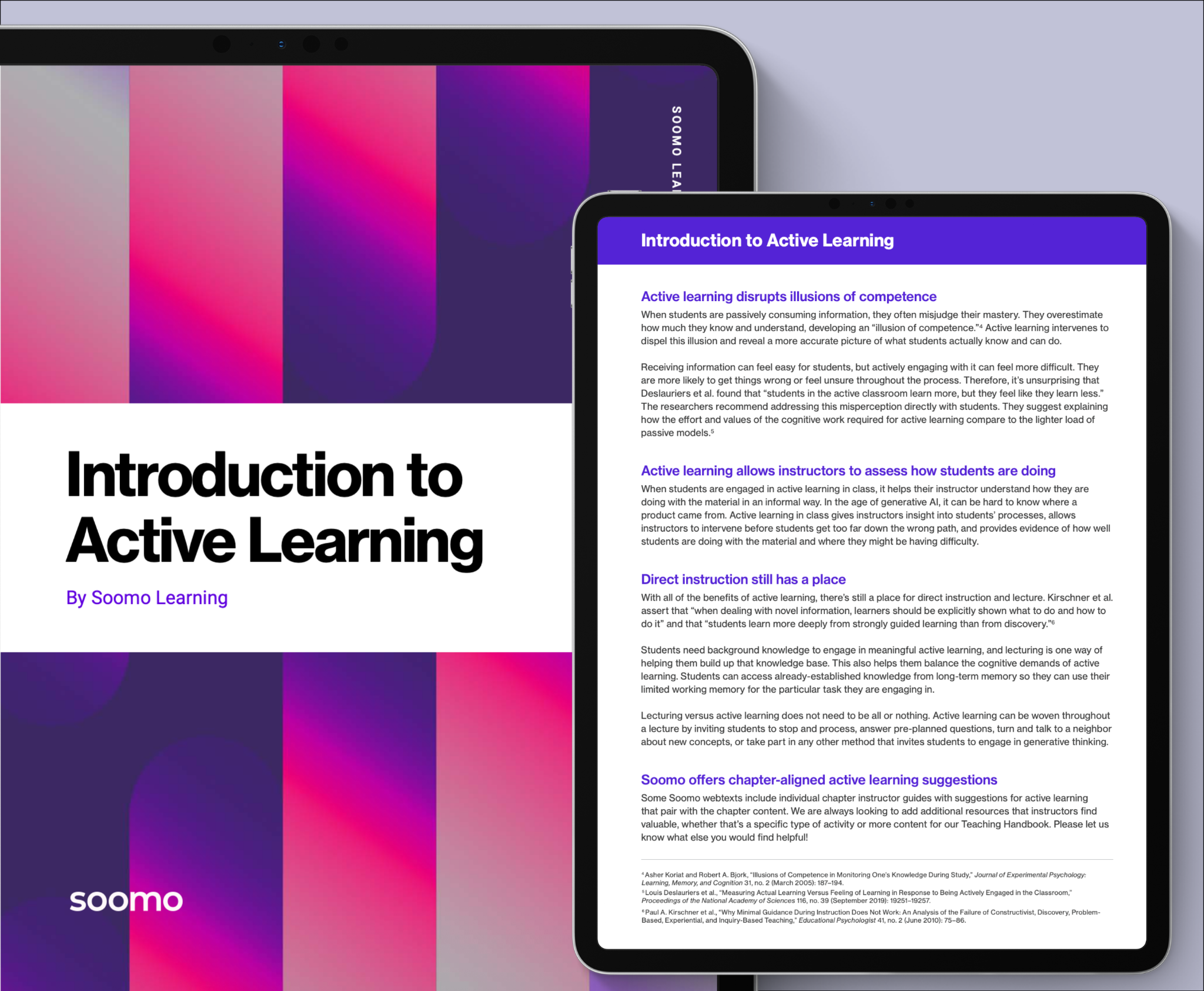
The Teaching Handbook offers guidance on planning, choosing, and facilitating activities
Available directly within Soomo webtexts, the Teaching Handbook focuses on evidence-based teaching strategies and the instructional decisions that make active learning successful.
Working alongside our instructor guides, the Handbook helps instructors think through questions like these:
- What discussion structure makes sense for this learning goal and group of students?
- What strategies can encourage more students to participate in this particular class?
- How can I structure group work to support the learning outcome we’re working toward?
- How do I facilitate conversations that help students think more deeply about this chapter’s core concepts?
- How might I refine my approach before, during, and after an active learning activity?
%20(15).png)
To answer those questions, the Handbook provides practical, research-informed guidance across three key areas.
Planning active learning experiences
Successful activities begin before students enter the classroom. The Handbook offers practical tips on planning and preparing, including how to
- work through the activity in advance to gauge timing and define a strong answer,
- anticipate common misconceptions and prepare follow-up questions,
- decide how work will be completed and submitted, and
- use student data—such as webtext responses—to inform instructional decisions.
Choosing the right teaching structure
Different learning goals require different approaches. The Handbook explores a range of structures:
- think-pair-share
- small-group discussions
- concept mapping
- collaborative problem-solving
- whole-class conversations
- connecting concepts to examples
- analyzing scenarios and claims
Facilitating effectively
With strong facilitation skills, instructors can manage activities and discussions so that learning remains the main focus. The Handbook provides guidance to build and refine key facilitation skills, including
- grouping and pairing students,
- planning questions to scaffold thinking toward end goals,
- using wait time to give students quiet processing time,
- responding to student thinking to extend ideas and maintain momentum, and
- synthesizing and debriefing to wrap up key takeaways and guide reflection.
These practical strategies and tips to develop your facilitation skills can help you consider how to adapt an activity for your students, learning goals, and teaching context.
The right resource can make a difference
Whether you’re introducing active learning for the first time or looking for new ways to engage your students, having trusted resources can make the process easier.
We created the Soomo Teaching Handbook to help instructors turn research into action—providing practical, evidence-based guidance for the everyday decisions that shape student learning.
If you’re interested in exploring any of our webtexts, you can preview any title in our catalog by filling out this short form.
Sources
Scott Freeman et al., “Active Learning Increases Student Performance in Science, Engineering, and Mathematics,” Proceedings of the National Academy of Sciences 111, no. 23 (May 2014): 8410–8415.
Anastassis Kozanitis and Lucian Nenciovici, “Effect of Active Learning Versus Traditional Lecturing on the Learning Achievement of College Students in Humanities and Social Sciences: A Meta Analysis,” Higher Education 86 (December 2022): 1377–1394.


You may also like


.jpg)



Stay in touch

An error has occurred somewhere and it is not possible to submit the form. Please try again later or contact us.

Five main reasons to sign-up for our newsletter


