.svg)


Finally, a biology text that meets nonmajors where they’re at

John Alfieri

8 minutes

The study that started it all
A few years ago, science writer and editor Trevor Quirk came across a research study that stopped him in his tracks. The study looked at what happens when nonmajor biology students end up in courses designed for majors—a common scenario. The findings were, in the words of the study’s author, “just fascinating.”
Nonmajors were far more likely to fail or withdraw when placed in courses that weren’t built with them in mind.
Trevor reached out to that author, Farshad Tamari, a professor at CUNY’s Kingsborough Community College with over 18 years of teaching experience. And the two of them teamed up to build a text specifically for nonmajor students. That text became Biology: Life at Every Level.
I recently sat down with both authors to ask them all about it.
.png)
Why do nonmajors struggle in traditional biology courses?
Farshad: Unlike majors, nonmajors come to the course thinking it’s going to be impossible to do well, and that affects their performance. It’s a self-fulfilling prophecy. After a while, you just believe it. You don’t put an effort forth, and therefore, you don’t learn. Science builds on previous topics. So you fall behind even more with the next lecture. And then at one point, you’re saying to yourself, “My goodness, I don’t even understand a single word my professor is saying.”
If a student is a nonmajor, you have to provide them with material appropriate for their level; otherwise, the likelihood of the students succeeding dramatically drops. And I think this webtext does a really good job at presenting nonmajors the material at a level better suited to their needs.
How did you make the course content more appealing to nonmajors?
Farshad: One of our biggest assets here is our structure of the presented topics. That’s one thing I’ve found in my many years of teaching to help students most, other than the content itself. For biology students specifically, if they’re to succeed, you have to give them a structured course where it’s almost impossible for them to get lost. And this book does that. The themes and big ideas are presented in a structured way and broken down into units, chapters, and sections so that the flow is logical and comprehensive and students always know where they are contextually.
Trevor: Beyond structure, we also made a lot of decisions that basically all fell into one of three overarching strategies we used:
- engagement
- simplification, and
- connection.
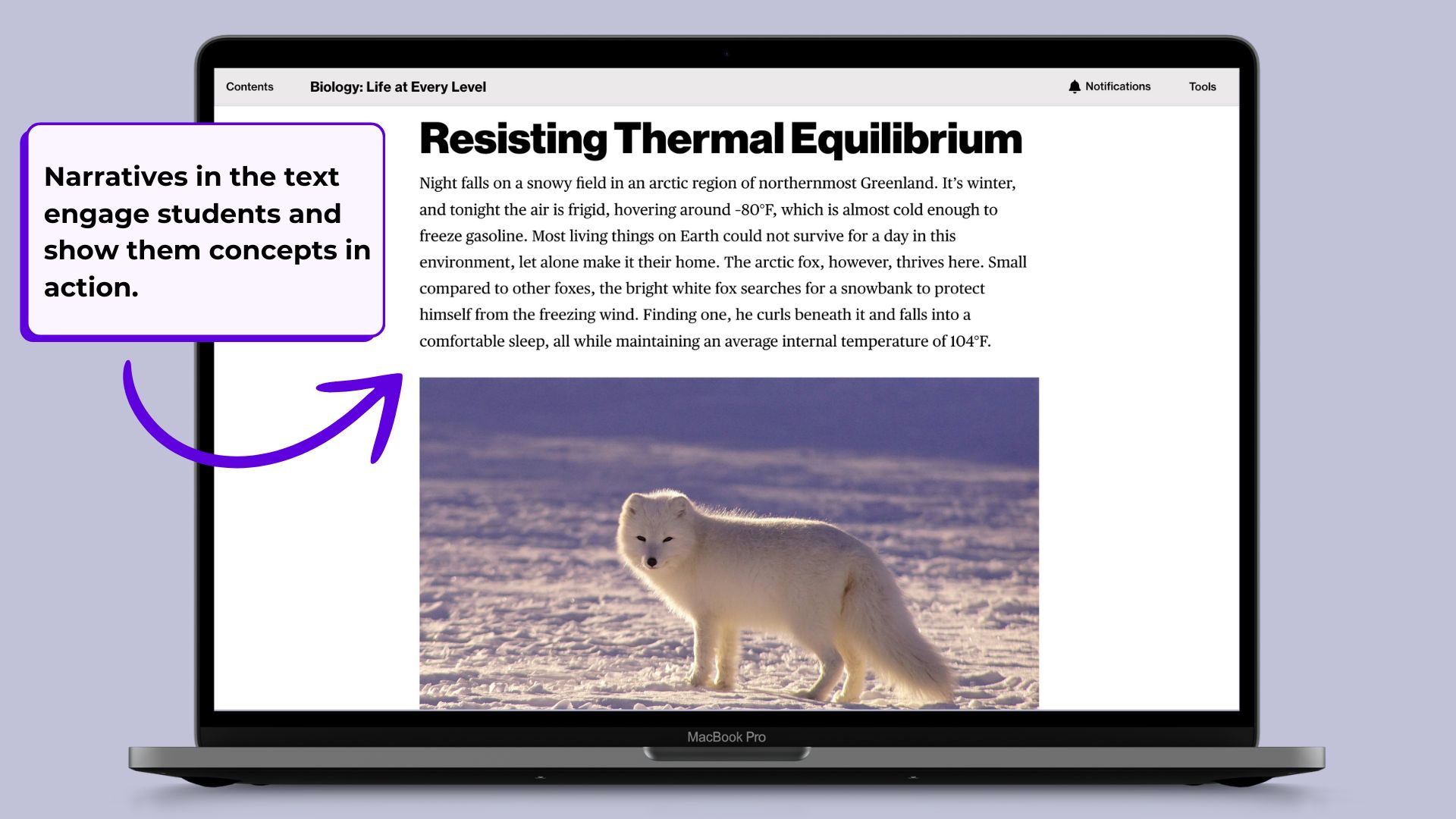
We engage students through narratives and analogies—often reframing concepts in new ways to make them easier to grasp. We simplify or exclude technical details. And we constantly make connections between concepts to illustrate how everything we’re talking about relates to one single thing: life.
How did you decide what to include—and what to leave out?
Trevor: The short answer is that we built the webtext around a few big ideas. They’re simple enough to remember but complex enough to break down into units, chapters, and page-level content. So, for example, one of our big ideas is “Living things need energy to organize themselves in a universe that tends toward disorder.” Any technical language that doesn’t serve the big ideas, we toss out.
.png)
It’s easy to forget the cognitive overload that can happen when you look at a page and half of it is in a language you don’t understand. Reducing that cognitive load by adjusting vocabulary goes a long way. So we took out as much technical detail as possible—and we would stress as much as possible. We never took it out when it was to the detriment of the student’s understanding.
So, for example, most textbooks name each of the phases of mitosis and meiosis. We don’t. We decided it doesn’t matter. What really matters is if the student understands the basic mechanics of what’s happening in these processes. So when you use a phrase like anaphase, it incurs a cognitive cost that could otherwise be spent focusing more on the conceptual material of what mitosis or meiosis is really about.
You can see this approach by looking at our illustrations. Unlike many texts, ours don’t overwhelm students with unnecessary detail.
What features help students stay engaged and on track?
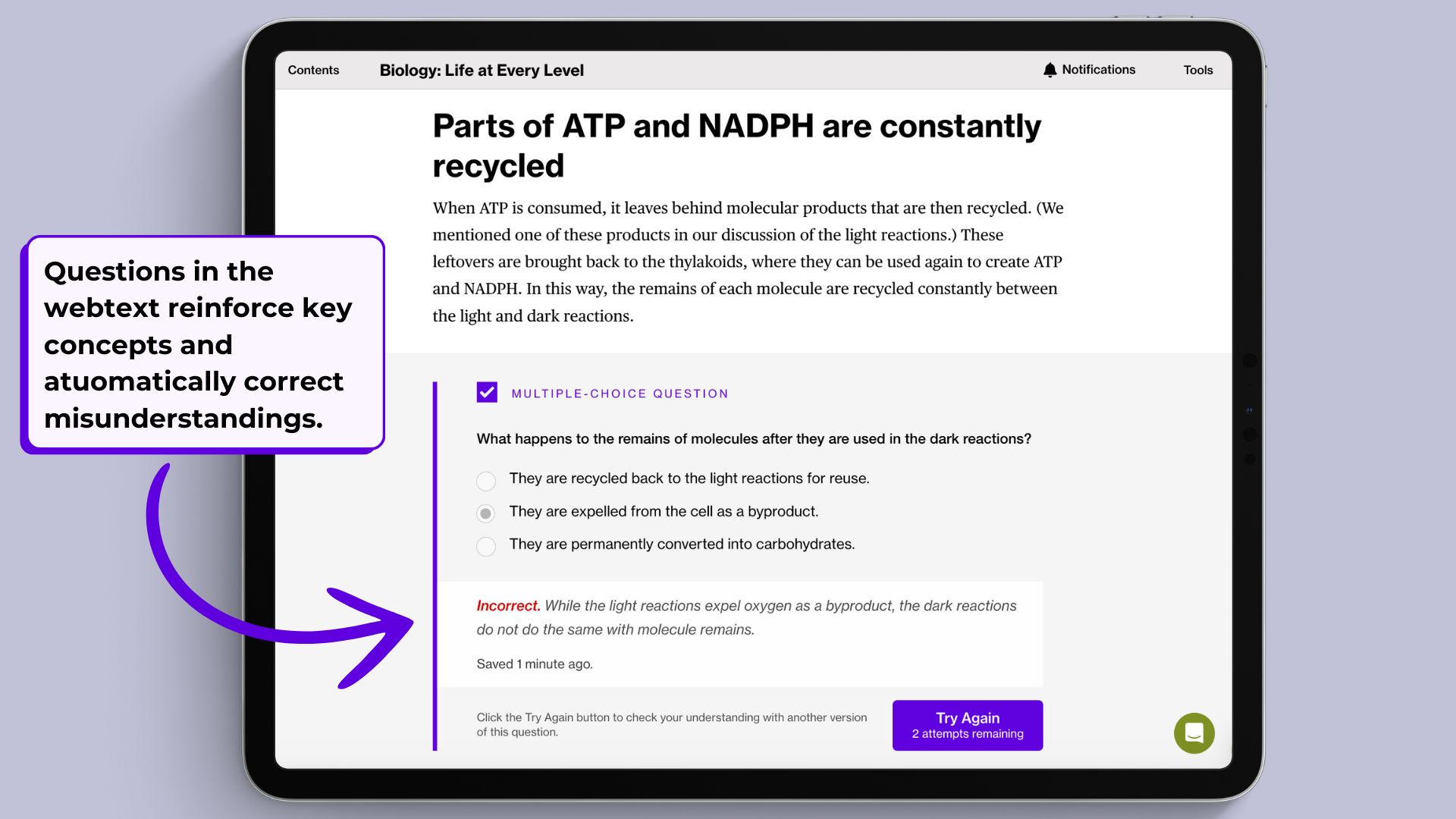
Trevor: Our platform plays a huge role. Each page includes automatically graded multiple-choice questions, and every chapter ends with a quiz where students apply concepts to real-world situations. These assessments ensure students are doing the reading and absorbing all the important information.
Farshad: The literature shows that low-stake assessments are incredibly effective. I found that my best undergrad instructors used exams as a learning tool as well as an assessment. And they would explain why I got a question wrong. We have employed this approach because it benefits students.
When students get a question wrong in the webtext, they immediately see an explanation. And it reinforces a topic and corrects misunderstandings, which is wonderful. That’s the point of teaching: to use every tool at our disposal to make learning possible.
What do you hope students take away from the webtext?
Farshad: I want students to gain competencies beyond the classroom. I want them to have learned the material so well they’ll apply it to their own lives later. For example, in the genetics unit, they learn how traits are inherited. That helps them understand real-world issues like genetic diseases or family health histories. The material applies directly to their lives.
Trevor: For nonmajors, this could be one of their few formal contacts with the sciences. One of our goals is to give them a sense of what it means to explain something scientifically and why that’s so useful for understanding and also manipulating our world. Understanding what it means to explain how the human body works also gives you a sense of how to fix things when they don’t work the way that we want them to.
Explore the webtext!
If you’re interested in Biology: Life at Every Level, you can access the webtext right now. Just visit soomo.co/bio.


You may also like
.jpg)


.jpg)

Stay in touch

An error has occurred somewhere and it is not possible to submit the form. Please try again later or contact us.

Five main reasons to sign-up for our newsletter


