.svg)


Building Civics Reader: Making Primary Texts Work for Today’s Students

Jocelyn Evans

8 minutes
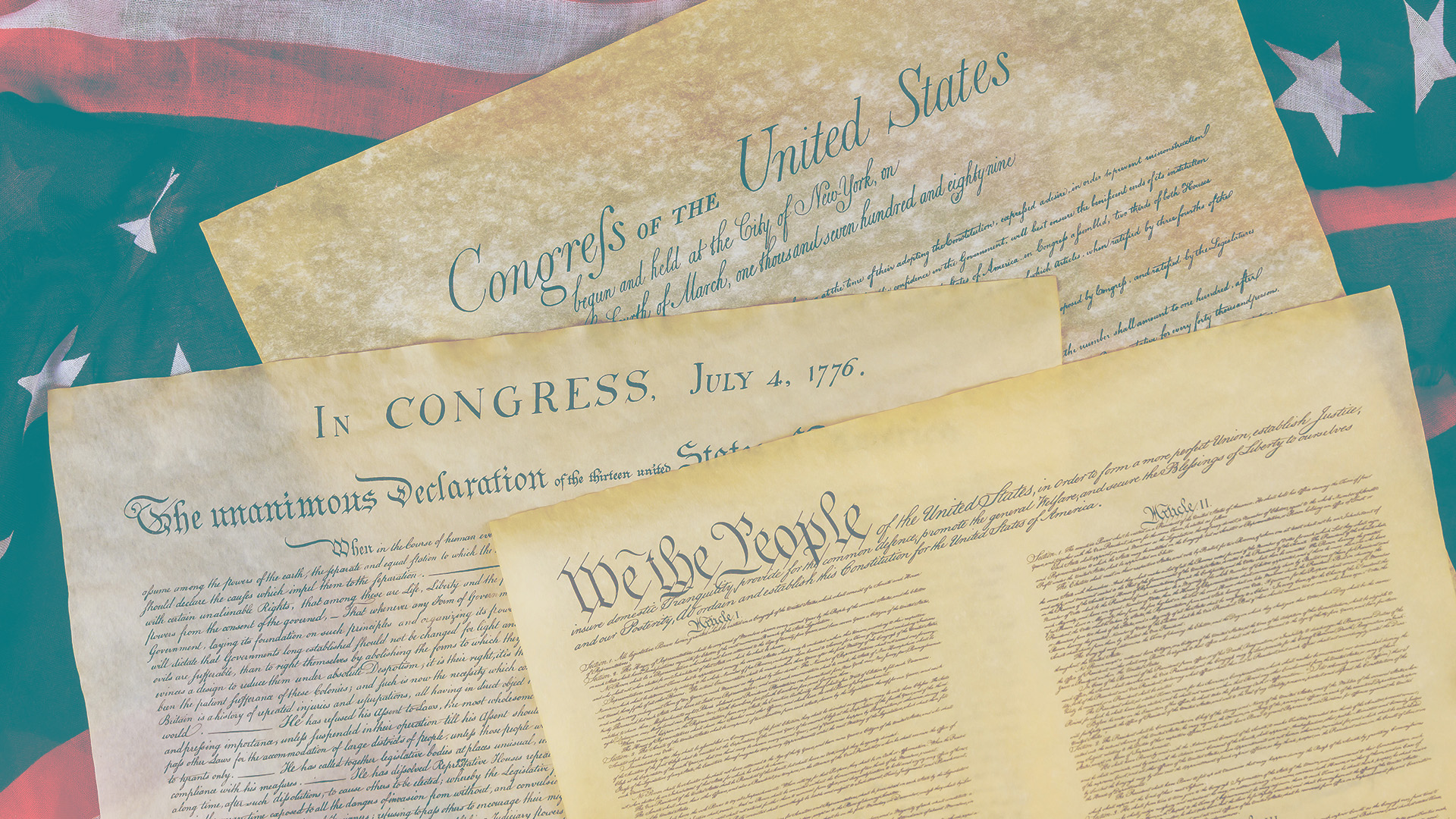
Foundational documents have always played a critical role in teaching American government. But as our democracy continues to evolve and face new challenges in the modern age, and as the nation turns 250 this year, it feels more relevant than ever to help students engage with these documents.
State legislatures recognize this need too. We’re seeing more mandates across the country requiring undergraduates to read specific civics texts.
Critical engagement with primary texts is something all of us in this discipline support. We all wish for a strong foundational understanding of key documents that might inform a more civically engaged student body. But reaching that goal, getting students to engage meaningfully with these texts, can be extremely difficult.
Many of us know we have to assign these texts now, but how do we actually teach them well?
As a political science professor at University of West Florida, that’s the question I’ve been contemplating, and it’s why I partnered with Soomo Learning to develop Civics Reader.
%20(7).png)
We developed Civics Reader around common challenges, institutional pressures, and state mandates
Last summer I participated in a virtual symposium hosted by the American Political Science Association on the theme of “Teaching Introduction to American Politics in Times of Uncertainty.” The faculty who joined me from across the country represented diverse institutional contexts. They faced a variety of sociopolitical pressures to
- improve civics education,
- demonstrate student skill development, and
- generate meaningful engagement through real-world application.
Many of us teach in states with new civics requirements. Some of these states, including my home state of Florida, now mandate that
- students must enroll in specific courses
- professors must cover specific primary texts in their courses, and
- students must pass a civic literacy exam prior to graduation.
In short, our classrooms now have a mandated role to play in socializing students to democratic citizenship.
Yet the challenges of the college classroom are more daunting than ever.
The challenges of teaching civics today
Students are more anxious about political conversations, more cynical about the future, and more distracted than ever. They would much rather be on their phones than in conversation with me or each other.
Plus, most students simply don’t do the assigned reading. A few years ago, Soomo Learning conducted a study with my introductory webtext, Central Ideas in American Government. They found that only about 12 percent of students engage with assigned reading when it isn’t tied to course credit. (That number jumps to roughly 85 percent when it’s assigned for credit).
Even when students do engage with the reading, 18th-century prose is genuinely hard to understand. Rows of dense text without any intentional scaffolding don’t just bore students. The language actively shuts them out of the conversation.

On top of everything else, most existing readers are too expensive, too partisan, or simply too static for a classroom where students expect interactive, digitally-native materials.
To address the demand for civics education through primary texts, I didn’t just want to build a compliance tool. I wanted to build something I’d actually want to assign in my own course.
What’s inside Civics Reader?
Civics Reader is a low-cost, interactive webtext that pairs canonical U.S. primary texts with the scaffolding and assessment students need to actually engage with them.s a low-cost, interactive webtext that pairs canonical American primary texts with the scaffolding and assessment students need to actually engage with them.
The reader currently includes:
- The Declaration of Independence,
- The Articles of Confederation
- The U.S. Constitution
- Federalist No. 10, 51, 70, and 78,
- Brutus No. 1
- Washington’s Farewell Address
- The Emancipation Proclamation
- The Gettysburg Address
- Dr. Martin Luther King Jr.’s Letter from Birmingham Jail
- State-specific constitutional materials where mandates require them
We introduce each document by first grounding students in the historical moment and the stakes before they read a single line of the original text. I wanted to meet students where they are and bring them up to where the text lives.
%20(11).png)
I also developed a framework to connect each document with fundamental principles of American government; this helps students appreciate why each document matters and understand how they connect to a broader and ongoing conversation about good and just government.
The learning design: scaffolding without dumbing down
The core pedagogical approach is a four-step process that runs through every primary text in Civics Reader:
- Start with a question. We begin each chapter with a guiding question, like “According to the Articles of Confederation, what constitutes a good or just government?”
- Consider the circumstances. We briefly describe the historical context and provide interactive timelines to ensure students have a solid foundation before they start reading the text.
- Read for details. We break texts into bite-sized chunks and separate those chunks with embedded multiple-choice questions that require students to slow down, pause, and follow the argument step by step.
- Reflect. We give students space for open-ended journal prompts at the end of each chapter and encourage them to use evidence from the text to answer the guiding question in their own words.
The four-step process isn’t the only thing that guides student learning. Several additional features are key to overcoming the challenges these texts pose:
- Definitions for unfamiliar vocabulary. Each text includes highlighted words and phrases students can click on or hover over to see definitions and even some historical context.
- Distractor rejoinders. When students incorrectly answer a multiple-choice question, they receive immediate, automatic feedback to correct misconceptions, so that a wrong answer becomes a teachable moment instead of a dead end.
- Question pools. Students who miss a question get another version of that same question and answer set, covering the same concept right away while discouraging students from mindless attempts.
- Study Stack. Every completed question lands in a personal practice deck students can revisit before exams.
- The key principles framework. I designed Civics Reader to trace nine key principles—popular sovereignty, federalism, separation of powers, checks and balances, limited government, individual liberties, majority rule/minority rights, republicanism, and the rule of law—across every text, so students can more easily connect documents to each other and to real-world politics. And this enables instructors to build thematic synthesis assignments too.
These aren’t just old texts. They are a window into a huge conflict over good government in the early years of our nation—and that conflict is still ours today.
But does Civics Reader actually work?
Yes! We began piloting Civics Reader last year in a few different schools. We’re so pleased to share that it’s received overwhelmingly positive feedback from both professors and their students.
Here are some of my favorite comments so far from early adopters:
- “I am loving this … it’s working.” – Professor Leah Murray, Weber State University
- “It has been an absolute game changer … The way the Civics Reader breaks down the texts into manageable bites and then asks students a question to check their understanding has been absolutely fantastic.” – Professor April Birchfield, A-B Tech
- “It frees me up to teach … it covers everything I need to cover to comply with the law and lets students work at their own pace.” – Professor Layne McDaniel, Appalachian State University
I love seeing that fellow professors appreciate the careful scaffolding we built into the webtext, and that our approach is freeing up instructors to actually teach. It proves that meeting state mandates doesn’t have to mean sacrificing good pedagogy or instructor autonomy. And this success isn’t limited to one type of classroom or one state. As of this writing, the webtext is currently being used in:
- Arkansas
- Florida
- Ohio
- North Carolina
- Texas
- Utah
- Oregon
The geographic spread matters to me. These are states with very different political cultures, very different legislative pressures, and very different student populations—and Civics Reader is flexible enough to serve all of them.
Why I’m spearheading work with APSA
The response from faculty has been extraordinarily positive. I know that I am not alone in thinking these mandates create a real opportunity for civics education. My next step is to take this conversation beyond a single product and into the discipline. Civics instruction is bigger than any one tool, and political scientists need shared resources, shared evidence, and shared pedagogy if we’re going to meet this moment well.
That’s why I’ll be leading a working group at the 2026 APSA Annual Meeting in Boston: “Civics Education in American Political Science—New Resources for a New Era.”
Building on the 2025 APSA Virtual Teaching and Learning Symposium, I hope to convene scholar-educators across institutional settings to workshop pedagogy, develop assessment approaches, and co-create new resources housed on APSA Educate.
Promised deliverables include participation in a one-day short course, two Journal of Political Science Education roundtables, and a research panel on early evidence of student success.
I’ve also recently participated in APSA’s “Engaging America’s 250th” webinar series as a panel member for Making the Founding Documents Relevant in the 21st Century—exactly the conversation the Civics Reader was built to support. If you’re interested in checking that out, APSA just made the full webinar recording publicly available.
.jpg)
A new pilot study (want to join us?)
I’m partnering with distinguished professor Leah Murray, PhD, of Weber State University to study how student engagement with foundational primary texts changes when delivered through the Civics Reader. We are inviting other faculty across institutional contexts who are using Civics Reader to survey their students as well.
These mandates demand civic literacy regardless of institutional type, so effectiveness across student populations has to be reflected in the evidence we generate.
While we are waiting until the fall to share the full results, the early data has been overwhelmingly positive! Early adopters are already distributing the survey to their students, and we’re currently inviting others to do the same.
If you are teaching an American government or history course and would like to pilot the Civics Reader, please reach out to join our study!
The takeaway: Civics education matters and so does our approach to teaching it
Political science has both a responsibility and an opportunity to lead the conversation about how we teach democratic values, founding principles, and civic participation.
My expectation with the Civics Reader is simple: Students who engage real texts, with meaningful context, intentional scaffolding, and small-stakes assessment do real work. So far, the early evidence—and the growing community of faculty using the webtext—suggests that expectation is a worthy one.
We fell in love with learning because our mentors guided our reading of original documents. We owe it to our students to pay it forward.
Interested in exploring Civics Reader? Preview it now by filling out this short form.
Want to join the APSA working group? Get in touch or visit APSA Connect to learn more.


You may also like



.jpg)

Stay in touch

An error has occurred somewhere and it is not possible to submit the form. Please try again later or contact us.

Five main reasons to sign-up for our newsletter


